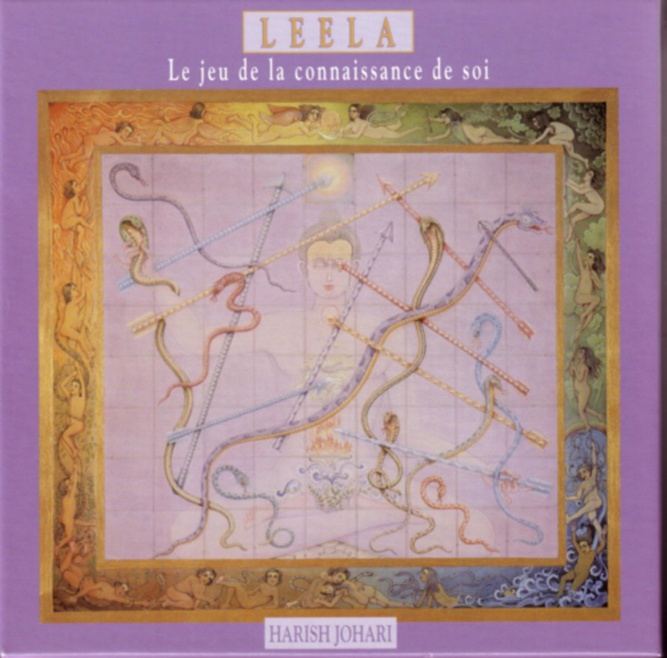
The game of self-knowledge
Leela
An ancient board game — snakes and arrows, from karma to dharma — that Samuel discovered at Findhorn in 1983 and translated into French in 1995. A genuine path of self-knowledge.
In 1983, during a stay at the Findhorn community in Scotland, Samuel discovered Leela, The Game of Self-Knowledge by Harish Johari. It became, alongside Astrology and the Yi King, one of his favoured tools for reflecting on and understanding his own life — at once a book of wisdom and a magical “game”.
Rooted in the Hindu tradition (Yoga, Advaita-Vedanta), Leela rests on the principle of “synchronicity” — the one C. G. Jung decoded — much like the Yi King or Dane Rudhyar's Sabian Symbols. One “incarnates” by rolling a six, then travels the great adventure of life through its ups (the arrows, leaps forward in Consciousness) and its downs (the snakes of our human condition). From karma to dharma, each roll mirrors our state of the moment and reveals the hidden meaning of our path. As Samuel writes: whatever happens, “you win every time”.
Translator’s Preface
In 1983, during a stay at the Findhorn community in Scotland, I discovered Leela, The Game of Self-Knowledge by Harish Johari. Ever since, this book has become one of my favoured tools for reflecting on and understanding my own life, alongside Astrology and the Yi King. Like the latter, it is at once a book of wisdom and a magical “game”.
Just as the Yi King rests on the Taoist vision of the Universe and Lao Tzu’s Tao Te Ching, Leela belongs to the broad perspective of Hinduism and its various currents, notably Yoga and Advaita Vedanta. To approach Leela is therefore also to immerse oneself in one of the oldest — yet also most “practical” — spiritual traditions. When I encountered it, my entire quest was founded — and still is — precisely, and most particularly, on this Hindu approach.
I spent a year in India — two stays of six months each, in 1978 and 1981 — to steep myself in this culture that had been calling me for years already, through various teachings whose quintessence I would rediscover in Leela: Ramakrishna and Vivekananda, Swami Ramdas, Ma Anandamayi, Sri Aurobindo, Ramana Maharshi, and Swami Prajnanpad through Arnaud Desjardins — to name only a few of those great figures of Hindu spirituality best known in France.
During my first stay in India, in 1978, I met my Master, Paramahansa Yogananda, whose teaching, Kriya Yoga, was revealed by that marvellous book, Autobiography of a Yogi. Leela thus truly became, for me, an exceptional working tool for understanding these various teachings and the sacred texts of Hinduism such as the Bhagavad-Gita or Patanjali’s Yoga Sutras. At the same time, I was discovering the Astrology of Dane Rudhyar — with whom I would go on to work in the United States in 1981 and 1982 — which also integrates this dimension, which is why it became the driving force of my work as an astrologer.
If Leela is the expression of a Tradition, it is also a game — a thousand-year-old game! Having “played” it many times over these years, alone or with other seekers, I know its power and force. As the author of the commentaries, Harish Johari, explains, it is founded on that same principle of “synchronicity” that animates the Yi King or Dane Rudhyar’s Sabian Symbols — the principle C. G. Jung decoded so well. The game consists in “incarnating”, that is, in leaving Cosmic Consciousness in order to return to it — what certain esoteric traditions call “the Path of Return” or “returning Home”.
After rolling the die and obtaining a six in order to incarnate, the great adventure of Life begins, with its ups (the arrows that make us leap forward in Consciousness) and its downs (the snakes of our human condition that send us back down to begin the journey again, once we have understood the “lesson”).
Each roll of the die is in “synchronicity” with our state of the moment and leads us to the square that will let us grasp the hidden meaning of our life at that precise stage. From this point of view, the book could just as well be titled “From Karma to Dharma”: our present state is the fruit of our past acts and thoughts (Karma); the game, through the self-understanding it brings, helps us to readjust, to attune ourselves to what is “right”, to harmonise with the Cosmic Law (Dharma).
Yet playing can hold many surprises. The first time I played, in 1983 in Aberdeen, in difficult circumstances of my life, I was morally certain I was in the right (cosmically, of course!) regarding the conflict I was living through with the other player. I had told myself the game would enlighten us both and that it “would show them a thing or two!” For me, there was no doubt the game would reveal their error!
And here is what happened: while my partner rolled a six straight away and incarnated, I had to wait a long time before I could do so myself. Then, as I made my way painfully across the squares and resentment and anger grew within me, my partner reached Supreme Bliss, the square of Cosmic Consciousness. I had to keep playing alone, face to face with myself; and it was only when I “let go” that I could reach the goal. My journey through the game had indeed brought my state of the moment to light. Needless to say, that first “game” remained engraved in my memory!
Thus the game invites us to understand that life is but a… game, and that taking it seriously holds many disappointments in store. Playing is a pleasure — also the pleasure of taking things with humour. Wisdom is the goal the game offers us — a wisdom that is also a certain form of holiness, which led Yogananda to say that “a sad saint is a sorry saint”.
The work of translation itself was truly initiatory for me: in a period of my life marked by great transformations, it brought me, if not many answers, at least many avenues of reflection as to the direction to take. Before playing, I suggest the reader first read the whole book, remembering that each square has meaning only in relation to all seventy-one others.
I thank the author, Harish Johari, for bequeathing us this jewel; my companion, Catherine, for sharing this translation work and the teachings of Leela; Véronique Massin for the proofreading and layout; and Yves Michel, without whose perseverance we would not possess the French version of Leela.
And now, dear reader, fellow seeker, the time has come for you to undertake to play the game of your life through Leela, knowing that, whatever happens, you win every time!
Samuel Djian-Gutenberg — Lucinges (Haute-Savoie), May 1995