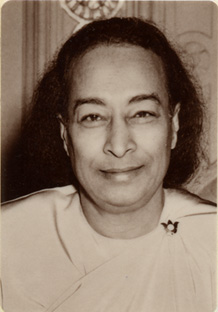
Master of Kriya Yoga, a bringer of Indian spirituality to the West. It is in his lineage that Samuel received the teaching during his journeys to India.
Paramahansa Yogananda was born on 5 January 1893 in Gorakhpur, in northern India.He became a monk of the Order of Swamis shortly after completing his studies at the University of Calcutta in 1915. In 1917, he began the work of his life by founding a school — at Ranchi, in Bihar — based on the principles of yoga. The official subjects were taught there alongside the essential principles of the spiritual life. There are today many schools operating on this model throughout India.In 1920, he was invited to represent India at the International Congress of Religions held in Boston, in the United States. His address, “The Science of Religion”, was remarkable and inspired.That same year, he founded the SRF — Self-Realization Fellowship. This international organisation (whose counterpart in India is the Yogoda Satsanga Society of India) has as its mission to transmit the teachings and philosophy of Yoga and the riches of meditation. Through these teachings, it seeks to help men and women of every race and religion to realise and fully express in their lives the beauty, nobility and divinity of their soul.For more than 30 years, Yogananda lived and taught in the United States. He counts today thousands of disciples throughout the world. His written work is very dense and is translated into most languages… except in France, where seekers often know only his Autobiography of a Yogi. In this best-seller of spiritual literature, he retraces the path of his realisation and of his mission as a spiritual master.
The discovery of India
In 1978 — an important year, since it corresponds to my meeting with Germaine Holley first and with Dane Rudhyar afterwards — the circumstances of life led me to India.Since I had discovered the Path, a few years earlier, the place of India had become more and more important within me. Quite naturally, everything connected to that country attracted and fascinated me.In my thirst for knowledge and realisation, I had first approached Buddhism in its various forms, particularly Zen Buddhism and Tibetan Buddhism. Zen Buddhism through reading D. T. Suzuki’s Essays in Zen Buddhism, and through the work of Alan Watts, a major figure of the American counter-culture who nourished me, like many others of my generation. The Spirit of Zen and Psychotherapy East and West were important elements of my reflection and my quest, as were Watts’s other works which, even when they did not speak directly of Zen as such, were applications of it: Nature, Man and Woman and The Wisdom of Insecurity, for example. Chögyam Trungpa initiated me into Tibetan Buddhism (Cutting Through Spiritual Materialism).Like many, this attraction to the spirituality that spoke to my soul manifested itself in the need to study every approach across the different cultures, so evident did it seem to me that, beyond the forms and the places, they answered the same fundamental need of every human being: self-realisation and liberation. Buddhism, then, but also Christianity (in its esoteric dimension), Taoism, esotericism, and so on. Likewise, just as much as into astrology, I plunged into the study of the Tarot, numerology, the Yi King…Yet, faced with this abundance, I felt I had to commit to one path. “Grasp all, lose all”, says the proverb, often quoted by Charles Vouga in his lectures. By touching everything, the risk is to lose oneself and remain on the surface. Although I have always continued to steep myself in all the spiritual philosophies, as in all the forms of psychology and esotericism, India imposed itself upon me, just as astrology did at the level of tools.The symbolism of astrology, when I discovered it, was familiar to me, and the more I immersed myself in it, the more I felt in known territory. When I had shared this feeling with her, Germaine Holley said to me, showing me what it corresponded to in my chart: “You are an old astrologer; you are only finding again what is within you.”This same feeling inhabited me when I immersed myself in the philosophy of India, in Hinduism and the various forms of yoga. The concepts were instantly clear and evident in my mind, and the Sanskrit words spoke to me effortlessly. I had the impression that what I was reading was an integral part of myself, at an almost cellular level. I read everything I could find at that time, when there was not yet the immensity of publications one finds today.
The Indian Masters
My thirst to learn and to know was insatiable. Everything that spoke of India, of Hinduism, of the various yogas, drew me like a magnet, and when I read, my soul was bathed in light and my whole being was filled with joy. A few years after consciously beginning the quest, I joyfully found in Rudhyar the same concepts concerning the evolution of consciousness and the realisation of the Self. And Rudhyar offered an astrology of awakening, of consciousness and of transcendence. I knew then that I had found the astrology that matched my inner quest.Before this confluence, I pursued in parallel my studies in astrology and my search through the various spiritualities, mainly yoga and Hinduism. One of the pioneers, in France, of this meeting between East and West was Jean Herbert. His books, as well as those of certain great masters whom he had published, nourished this reunion with that part of myself that resonated with the great spaces of consciousness. Swami Ramdas, Ramana Maharshi, Ramakrishna and his disciple Vivekananda (to whom Romain Rolland devoted two biographies), Sri Aurobindo and others still were lights that illuminated my path. Arnaud Desjardins introduced me to Swami Prajnanpad, and his approach struck me as eminently practical. For one of the great problems we face, when we tread the Path, is to put into practice in our daily life all these teachings we receive. Sometimes we believe we have arrived simply because the concepts appear clear in our mind, which is already a first step. Transpersonal astrology helps us in this journey by allowing us to understand, through the dialogue we have with the person consulting, the stage in which they find themselves.
India
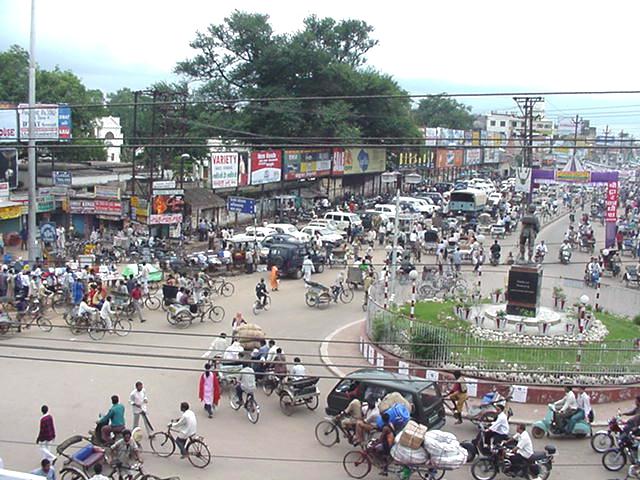
Some time before leaving for India, I was reading Arnaud Desjardins’s À la Recherche du Soi (In Search of the Self). I felt perfectly in agreement with the teaching of Swami Prajnanpad, and my desire was to meet such a Master. At one point, Arnaud Desjardins spoke of Swami Prajnanpad’s ashram, which was at Namkun, in the suburbs of Ranchi. I rushed to the map of India and finally managed to locate Ranchi, in Bihar, roughly halfway between Benares and Calcutta. I was to land in Bombay and after that did not know where to go. I set Ranchi as my point of arrival in case I had not found before then what I had come to seek.When I landed in Bombay, I was immediately caught in the whirlwind of India. It was as if I had received a blow to the head, and I found myself haggard, lost, with no points of reference. As the days passed, I followed the itinerary I had set myself, gradually moving northward according to the encounters and exchanges. But I advanced as though in an unreal world, and everything I did cost me enormously. I made this whole journey with the woman I had met in Paris. It was she who had decided me to come to India. Her son, then six years old, was with us. My relations with this woman, which had been relatively harmonious before our departure, turned into a genuine confrontation as soon as we arrived in Bombay. As we continued on our way, our relationship deteriorated and became violent. But we could not manage to part, so difficult did it seem to find ourselves alone in this immense country, so foreign to our Western ways of functioning. Paradoxically, while caught in this tension and this loss of myself, I felt in a known place: everything was foreign to me and yet everything was familiar. Beyond the drama I was living, I discovered a strength that slept within me and that had never expressed itself until then. In this magical country, I lived one of the major initiations of my life: I was being born to myself through all the spirituality that pervaded that land.And so we went up toward the North, then turned eastward. From town to town, the magic worked. After many adventures, we arrived in Benares, the holy city. Despite the beauty of the city and its spiritual richness, we were once again swindled by an individual claiming to be a yogi, who came every morning to have us meditate.We set off for Ranchi, which lies off all tourist routes. We arrived after nightfall and waited until the next day to go to Namkun. The rickshaws left us in a tiny village half an hour from Ranchi. No one had ever heard of “Swamiji”; the best would be to ask at the neighbouring college, where the bourgeoisie of Ranchi sent their children. The headmaster received us warmly, delighted to take chai with Westerners. Then he told us that the ashram we were looking for was no doubt the one in Ranchi, near the station, for he knew that “westerners” went there and that the swamiji we spoke of received “westerners”. He placed his driver at our disposal, and off we went again toward Ranchi. He drove us right up to the ashram in question, entering its enclosure honking the horn all the way.I had barely set foot in the ashram when I knew I had reached my destination. I, who had been so tense since my arrival in India, so anxious, suddenly felt peace descend within me. We were welcomed by an American Swami who told us he did not know the Swamiji we were seeking. Here, we were at the ashram created by Yogananda in 1918.Ranchi
Meeting Yogananda
Swami Bhavananda told us the story of Yogananda and explained to us the nature of his teaching. It was exactly what I was seeking. From the Swami emanated such peace and such light, together with such inner joy, that I felt transported into another dimension of myself. He told me that perhaps this was the teaching I was looking for, perhaps not. The best way to know was to spend some time at Ranchi and, possibly, to take part in the morning and evening exercises and meditations. He advised me to read the Autobiography of a Yogi to gain an approach to Yogananda and Kriya Yoga. That is how I met Yogananda and began my path in Kriya Yoga.I stayed for the rest of my time in India at Ranchi, where we had rented an outbuilding in the garden of the house of a magistrate of the town. It was our home base, to which I returned after stays in Benares or Calcutta.This first stay in India lasted six months and was marked by other adventures. When I returned to France, I continued the study and practice of Kriya Yoga while connected to the SRF in Los Angeles. The teachings I received in this field integrated quite naturally into my practice of astrology and even constituted its foundation. They combined with the teaching of Germaine Holley and that of Dane Rudhyar. It is from these various experiences that, gradually, the astrology I develop today within the CRET took shape.
Return to India
In 1981, I returned once more to Ranchi and spent six months in India, with forays into the South — notably to Pondicherry and Auroville, on the trail of Sri Aurobindo — and into the North, where I stayed in the first foothills of the Himalayas to escape the hot season on the Indo-Gangetic plain. The village where I stayed for a time was called Dwarahat, mentioned by Yogananda in the Autobiography. It is there that Lahiri Mahasaya found his master Babaji, who transmitted Kriya Yoga to him with the charge of spreading it through the world — which Yogananda was called to do in the West.At Dwarahat there was a small ashram kept by a Swami of Yogananda’s Order and, higher in the mountains, a place of solitary retreat where I spent two weeks, taking the opportunity to roam the mountains and to reach the cave of Babaji, where the latter initiated Lahiri Mahasaya. This wonderful encounter is the subject of a chapter of the Autobiography: “An Enchanted Palace in the Himalayas”.In these mountains of Dronagiri — fruit of an episode of Hanuman in the Ramayana — I had the chance to meet a Frenchman from Dijon who had become a sadhu, with no remaining ties or passport. For two or three years he had been living this uprooted life, going from holy place to holy place, from ashram to ashram, for such is the law of the sadhus, who may not remain more than three days in the same place so as never to become attached. We were, within a year, the same age; a youth and adolescence, a revolt and a quest, nourished by the same culture and the same counter-culture; and moreover we came from neighbouring regions — everything brought us together, and it was quite naturally and instantly that we became friends. I introduced him to Rudhyar, a few of whose books I had brought with me to study them better. He was deeply moved by The Pulse of Life (Le Rythme du Zodiaque), which I gave him when I came to leave the region.At Ranchi, I received initiation into Kriya Yoga during a typically Indian ceremony. It was, of course, a powerful moment that marked my commitment to the Path that had opened to me two years earlier, in the astonishing circumstances I have recounted.
From India to the United States
This second journey to India, even though it was again rich in teachings, was in fact not planned. In the course of 1980, I decided that it was important for me to go and see Rudhyar in the United States. I corresponded regularly with him, but the imperious desire to meet him in the flesh grew ever stronger. I therefore decided to leave Paris in the first days of 1981 and prepared my departure for the United States. Rudhyar agreed to receive me, and I had made many contacts, notably with the University of Chicago. My request for a one-year visa seemed justified: I was going to California to work with Rudhyar on the translation of his work. My application file was well put together. But the United States embassy refused me the visa. At the time, I was disappointed: everything was in place for my departure. I had even let my apartment for a year. As I left the embassy, a luminous idea struck my mind: since the United States did not want me, why not return to India? The visa was granted to me immediately, and in the first days of 1981 I left France as planned — but not for the destination originally intended.As one knows when one is on the Path, everything has meaning; nothing happens by chance. What I learned in India during this second stay was of paramount importance in my journey. Yet I did not give up hope of one day seeing Rudhyar. On my way up toward the Himalayas, I spent a few days in Delhi. I told myself I should try my luck again for the United States, and I went to the American embassy to ask for a visa — which I obtained without difficulty.Just time to pass through Paris again, and there I was in the United States. I have related my stay in that country through my relationship with Rudhyar. But I also made countless other encounters. In particular, I went to the international headquarters of the SRF in Los Angeles, the very place where Yogananda lived for 30 years and taught Kriya Yoga to many disciples. Throughout the time I spent in the United States, I remained in close contact with disciples with whom I shared regular periods of meditation.Yogananda thus occupies the heart of my life, and his teaching is at the heart of all that I do.The Heart Chakra
Transpersonal Astrology and India (Published in the “Guide du Yoga et de l’Inde en France”, Éditions Terre du Ciel)
Although the techniques of Transpersonal Astrology are mainly founded on the principles of Western astrology, many of them derive from Hindu astrology.Yet, beyond the technical aspect, the philosophy that underlies Transpersonal Astrology is above all that of India, inasmuch as Samuel Djian has been, since 1978, a disciple of Paramahansa Yogananda and was initiated into the teaching of Kriya Yoga within the Yogoda Satsanga Society of India and the Self-Realization Fellowship in the United States, founded by Paramahansa Yogananda. While pursuing and deepening this Way, he has also drawn on the teachings of the great Masters of India: Swami Prajnanpad through Arnaud Desjardins, Sri Aurobindo, Ramana Maharshi, Swami Muktananda, Swami Ramdas, Ramakrishna, Ma Ananda Moyi…The quest for “liberation” and “enlightenment”, proper to the spirituality of India and to Kriya Yoga, is the foundation of every undertaking. In this perspective, the aim of Transpersonal Astrology is to enlighten the consultant on the meaning of their incarnation so that they may best attune themselves to the purpose of their Soul. It helps them to become aware of themselves, of their potentials and of the best moments to actualise them. It thus helps to understand the meaning of the great stages of life by integrating them into a holistic vision of the process of individual, collective and cosmic evolution. It allows the opening to the spiritual dimension, the passage from karma to dharma, the alignment of the personality with the soul.The Center for Transpersonal Research and Studies therefore offers, alongside the astrological training, a work of personal development with the birth chart as its support.

 The discovery of India