Lineage
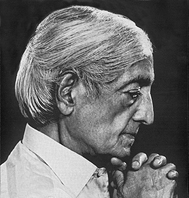
Jiddu Krishnamurti
Madanapalle, 1895 — Ojai, 1986
A thinker of inner freedom. Heralded in his youth as a “world teacher”, he renounced that role and all spiritual authority to teach but one thing: to free oneself from one’s conditioning.
“Of all the beings in this world, Krishnamurti is the one whose acquaintance would seem to me the supreme privilege…
His career, unique in the history of spiritual leaders, makes us think of the epic of Gilgamesh. Acclaimed in his youth as the future saviour, he renounced the role for which he had been prepared. He dismissed disciples, rejected guides and preceptors. He instituted neither faith nor dogma, questioned everything, cultivated doubt (especially in moments of exaltation) and, through heroic struggles and perseverance, freed himself from illusion and from the whirlwind of pride, vanity and all the subtle forms of domination over others.
He freed his soul, so to speak, from the lower and the higher regions, thus opening it to the ‘paradise of heroes.'”
Henry MILLER
“One name stands out among all — a name foreign to any notion tainted with secrecy, suspicion or confusion, to any notion of false erudition or intellectual slavery: that name is Krishnamurti, a man of our time of whom it may be said that he has been made master of reality — but who is also a being like no other.” Henry MILLER
In 1972, the encounter with Henry Miller was decisive for me, in that it determined the course of the rest of my life and marked the beginning of the definitive break with what my parents, my family, society… expected of me. In 1974, while pursuing a doctorate in Political Science and in my second and final year at the Institut Français de Presse et des Sciences de la Communication (IFP), an intern at the newspaper “Le Monde” — the ultimate posting for a budding journalist — the decision to stop everything and devote myself to what seemed right for me imposed itself upon me. I dropped the academic world and the prospects of “great careers” that lay before me, for a hypothetical and improbable future. I must say that, in a way, this new direction my life was taking, while it exhilarated me on one side because I felt it was calling me, frightened and distressed me on the other, for I could not see how I would ensure my material survival.
In those years, the whole movement now called “personal development” did not yet really exist; in any case there were not all these therapists, groups and teachings that can be supports during periods of radical transformation and reorientation. I had fear in my belly when I thought of my future, but the intense exhilaration that filled me, the feeling too of a great freedom, the deep joy of discovering a true meaning to my life — all this swept away my doubts and my anxieties and made me move forward without further hesitation. As if by magic, I found a maid’s room on the rue de Rennes and a part-time job as an archivist in a company with its head office near the Gare Saint-Lazare. I worked in the mornings and spent my time in the afternoons and late into the night reading Henry Miller and all the authors he spoke of in his books, walking around Paris on the trail of Miller and other writers and artists who had nourished, or were nourishing, my quest.
It was at that time too, still under Miller’s impulse, that I began to study astrology, the esoteric sciences, yoga and the various religions. Among the authors Miller spoke of — and whom I therefore went to discover — was a certain Jiddu KRISHNAMURTI. One phrase of his, cited by Miller, produced a genuine click in me. It said roughly this: “Gentlemen, you politicians who want to transform the world, you who want to transform others — begin by transforming yourselves!” This injunction, which may seem obvious today to all those who have engaged in a process of personal development, was not really so at that time. I came from a politicised milieu; I had myself, at a certain period, been involved with conviction in movements whose very mission was to transform the world.
This desire to work toward the emergence of a better and more just world through political commitment was, for a long time, self-evident to me. That, indeed, is why I had undertaken my studies in political science. Yet when I rubbed shoulders with all these passionate activists, driven by genuine conviction and whose good intentions I did not doubt, I felt a kind of unease deep within me: how could one continue to behave, in daily life, like an unconscious person while professing such lofty ideals? It seemed to me that if one truly wanted to change things, one had truly to begin to change them in everyday life — by learning to love better, to consider the other and others better, to raise children better, to be open to the otherness of the other, to make love better… When, timidly, I tried to express this feeling in the political meetings I attended, I was at once branded a “petty-bourgeois individualist”, selfish and romantic.
Little by little, I withdrew from all political commitment but, through upbringing and conviction, politics continued to be an important parameter in my perception of the world. How, I asked myself, can a more just world be born, if not by transforming the socio-economic framework that conditions us and prevents us from being truly ourselves? But I realised that this did not really work, for in all the countries that had radically transformed the old constraining structures, no greater well-being had appeared; and even if, in some of these countries, the material condition of the population may have somewhat improved, what I believed to be the true meaning of transformation had not taken place — quite the contrary. So this phrase of KRISHNAMURTI’s was for me a genuine revelation. I then undertook to read all his talks and books, and what I had confusedly felt forever found itself illuminated and confirmed by this man of high moral and spiritual stature.
With hindsight, reading or rereading today (December 2006 – January 2007) some of these texts, I become even more acutely aware of the role this man played in my life during that period of rupture of which I speak. He confirmed me in my choices and, no doubt more than any other, gave me the courage to accomplish that break by giving it its meaning and its depth. This I have always known; but in this period when I am living the second return of Saturn — at once a time of reckoning and of preparation for the third cycle — this fact appears to me even more… evident! During these thirty years, I have followed the path that I retrace elsewhere, to bear witness to my journey both as an astrologer and as a seeker of truth. I have not forgotten Krishnamurti — far from it — especially as I often cite that famous phrase (“Gentlemen, you politicians…”) in my seminars and lectures.
In this hour of reckoning, the “circumstances of life” bring me face to face with his thought again, as if to say to me: “Come now — what this man said, which had such impact in your life, has it remained a dead letter, mere intellectual reflection, or have you truly put it into practice in this life?” In many respects, my engagement in life has indeed followed the impulse given by Krishnamurti, notably this necessity of breaking with the framework of the prison. For having been as faithful as possible to that commitment, my social and material situation is not especially reassuring. In a more subtle way, as regards the inner transformation to which Krishnamurti invited me thirty years ago, and to which I have devoted precisely these thirty years, I must admit that I am still far from the mark, even if I also have the feeling of having advanced somewhat. It would be presumptuous of me — even if intellectually I have learned to master the concepts, the ideas, the tools, even if in practice I embody them in my life — it would be presumptuous to say “there, I have arrived”!
At this stage of my life, the observation I can make is that, while the awareness of the stakes and of the meaning is truly there, deeply rooted, in many respects I still behave clumsily — meaning, in a way still motivated by old patterns. In short, the break with the external system, as Krishnamurti says, is not sufficient, even if it may seem necessary. In fact, the hardest and least obvious thing is the total break with what that external system has imprinted in us as inner patterns — and it is precisely with those that the journey of transformation is made. And this is the very meaning of life: that this journey is the work of a whole life, of several lives. I see more and more, around us, individuals who proclaim themselves “awakened”, or whom others regard as such. Without any doubt, to be “awakened” and totally “liberated” is the ultimate goal. As for me, at this precise moment, I no doubt feel more conscious than I was thirty years ago; I clearly know — as far as I am concerned — what my goal and my purpose are, but I know, just as clearly and in all honesty, that the work continues permanently. It is this consciousness and this Path that I wish to share through my seminars, notably within my school of astrology — for, from this point of view, astrology is a tool of consciousness.
It is also in this spirit that I would like to share with you these few extracts from Krishnamurti’s texts which were essential in the journey of my life. May they inspire you too! If you take the time to read these texts and, moreover, you are also an astrologer or interested in astrology — particularly the Astrology of Consciousness that is Dane Rudhyar’s — and if, further, you have truly read Rudhyar (not only the books on astrology, but those bearing witness to his profound reflection on the meaning of life and of the world, such as The Rhythm of Wholeness or The Planetarization of Consciousness), you will realise how close Krishnamurti and Rudhyar are in formulating — each in his own way — the necessary transformation of our vision of the world and of our “being in the world”. For thirty years, following that great rupture, I have studied astrology in this sense with Germaine Holley and Charles Vouga on one side, and Dane Rudhyar on the other (without neglecting the contributions of Tradition, nor what every sincere astrologer has been able to share of his research, whatever his school).
I have studied many spiritual teachings, various approaches in depth psychology (notably Jung, with Claude-Marc Perrot, who was my analyst before becoming my friend) and in humanistic and transpersonal psychology (Abraham Maslow, Carl Rogers, Stanislav Grof, and particularly the Psychosynthesis of Roberto Assagioli). I have explored the esoteric sciences in all their forms. And, of course, I have taken part in many training seminars in different fields. I have tried, as best I could, to put into practice in my daily life — through the prism of my own individuality as my birth chart reveals it, with its challenges and its potentials — all that I have received. Above all, Life itself has been, and continues to be, my greatest Master…
If I recount all this, it is not to show off and say “Look what I have done”! It is, once again, to bear witness to a journey, with its great moments of intense openness and transformation and its great moments of questioning and descent — which are, moreover, also great moments of intense openness and transformation. What I also mean is that all these seekers to whom I refer, who inspired me, guided me, helped me to move forward, all speak of the same necessity of transcendence (of the “sublime”, as Assagioli said). In these times so important for the becoming of humanity, in this period of elections when politics dramatically returns to the forefront, it is good also to read, or reread, what Krishnamurti says of it:
In 1972, the encounter with Henry Miller was decisive for me, in that it determined the course of the rest of my life and marked the beginning of the definitive break with what my parents, my family, society… expected of me. In 1974, while pursuing a doctorate in Political Science and in my second and final year at the Institut Français de Presse et des Sciences de la Communication (IFP), an intern at the newspaper “Le Monde” — the ultimate posting for a budding journalist — the decision to stop everything and devote myself to what seemed right for me imposed itself upon me. I dropped the academic world and the prospects of “great careers” that lay before me, for a hypothetical and improbable future. I must say that, in a way, this new direction my life was taking, while it exhilarated me on one side because I felt it was calling me, frightened and distressed me on the other, for I could not see how I would ensure my material survival.
In those years, the whole movement now called “personal development” did not yet really exist; in any case there were not all these therapists, groups and teachings that can be supports during periods of radical transformation and reorientation. I had fear in my belly when I thought of my future, but the intense exhilaration that filled me, the feeling too of a great freedom, the deep joy of discovering a true meaning to my life — all this swept away my doubts and my anxieties and made me move forward without further hesitation. As if by magic, I found a maid’s room on the rue de Rennes and a part-time job as an archivist in a company with its head office near the Gare Saint-Lazare. I worked in the mornings and spent my time in the afternoons and late into the night reading Henry Miller and all the authors he spoke of in his books, walking around Paris on the trail of Miller and other writers and artists who had nourished, or were nourishing, my quest.
It was at that time too, still under Miller’s impulse, that I began to study astrology, the esoteric sciences, yoga and the various religions. Among the authors Miller spoke of — and whom I therefore went to discover — was a certain Jiddu KRISHNAMURTI. One phrase of his, cited by Miller, produced a genuine click in me. It said roughly this: “Gentlemen, you politicians who want to transform the world, you who want to transform others — begin by transforming yourselves!” This injunction, which may seem obvious today to all those who have engaged in a process of personal development, was not really so at that time. I came from a politicised milieu; I had myself, at a certain period, been involved with conviction in movements whose very mission was to transform the world.
This desire to work toward the emergence of a better and more just world through political commitment was, for a long time, self-evident to me. That, indeed, is why I had undertaken my studies in political science. Yet when I rubbed shoulders with all these passionate activists, driven by genuine conviction and whose good intentions I did not doubt, I felt a kind of unease deep within me: how could one continue to behave, in daily life, like an unconscious person while professing such lofty ideals? It seemed to me that if one truly wanted to change things, one had truly to begin to change them in everyday life — by learning to love better, to consider the other and others better, to raise children better, to be open to the otherness of the other, to make love better… When, timidly, I tried to express this feeling in the political meetings I attended, I was at once branded a “petty-bourgeois individualist”, selfish and romantic.
Little by little, I withdrew from all political commitment but, through upbringing and conviction, politics continued to be an important parameter in my perception of the world. How, I asked myself, can a more just world be born, if not by transforming the socio-economic framework that conditions us and prevents us from being truly ourselves? But I realised that this did not really work, for in all the countries that had radically transformed the old constraining structures, no greater well-being had appeared; and even if, in some of these countries, the material condition of the population may have somewhat improved, what I believed to be the true meaning of transformation had not taken place — quite the contrary. So this phrase of KRISHNAMURTI’s was for me a genuine revelation. I then undertook to read all his talks and books, and what I had confusedly felt forever found itself illuminated and confirmed by this man of high moral and spiritual stature.
With hindsight, reading or rereading today (December 2006 – January 2007) some of these texts, I become even more acutely aware of the role this man played in my life during that period of rupture of which I speak. He confirmed me in my choices and, no doubt more than any other, gave me the courage to accomplish that break by giving it its meaning and its depth. This I have always known; but in this period when I am living the second return of Saturn — at once a time of reckoning and of preparation for the third cycle — this fact appears to me even more… evident! During these thirty years, I have followed the path that I retrace elsewhere, to bear witness to my journey both as an astrologer and as a seeker of truth. I have not forgotten Krishnamurti — far from it — especially as I often cite that famous phrase (“Gentlemen, you politicians…”) in my seminars and lectures.
In this hour of reckoning, the “circumstances of life” bring me face to face with his thought again, as if to say to me: “Come now — what this man said, which had such impact in your life, has it remained a dead letter, mere intellectual reflection, or have you truly put it into practice in this life?” In many respects, my engagement in life has indeed followed the impulse given by Krishnamurti, notably this necessity of breaking with the framework of the prison. For having been as faithful as possible to that commitment, my social and material situation is not especially reassuring. In a more subtle way, as regards the inner transformation to which Krishnamurti invited me thirty years ago, and to which I have devoted precisely these thirty years, I must admit that I am still far from the mark, even if I also have the feeling of having advanced somewhat. It would be presumptuous of me — even if intellectually I have learned to master the concepts, the ideas, the tools, even if in practice I embody them in my life — it would be presumptuous to say “there, I have arrived”!
At this stage of my life, the observation I can make is that, while the awareness of the stakes and of the meaning is truly there, deeply rooted, in many respects I still behave clumsily — meaning, in a way still motivated by old patterns. In short, the break with the external system, as Krishnamurti says, is not sufficient, even if it may seem necessary. In fact, the hardest and least obvious thing is the total break with what that external system has imprinted in us as inner patterns — and it is precisely with those that the journey of transformation is made. And this is the very meaning of life: that this journey is the work of a whole life, of several lives. I see more and more, around us, individuals who proclaim themselves “awakened”, or whom others regard as such. Without any doubt, to be “awakened” and totally “liberated” is the ultimate goal. As for me, at this precise moment, I no doubt feel more conscious than I was thirty years ago; I clearly know — as far as I am concerned — what my goal and my purpose are, but I know, just as clearly and in all honesty, that the work continues permanently. It is this consciousness and this Path that I wish to share through my seminars, notably within my school of astrology — for, from this point of view, astrology is a tool of consciousness.
It is also in this spirit that I would like to share with you these few extracts from Krishnamurti’s texts which were essential in the journey of my life. May they inspire you too! If you take the time to read these texts and, moreover, you are also an astrologer or interested in astrology — particularly the Astrology of Consciousness that is Dane Rudhyar’s — and if, further, you have truly read Rudhyar (not only the books on astrology, but those bearing witness to his profound reflection on the meaning of life and of the world, such as The Rhythm of Wholeness or The Planetarization of Consciousness), you will realise how close Krishnamurti and Rudhyar are in formulating — each in his own way — the necessary transformation of our vision of the world and of our “being in the world”. For thirty years, following that great rupture, I have studied astrology in this sense with Germaine Holley and Charles Vouga on one side, and Dane Rudhyar on the other (without neglecting the contributions of Tradition, nor what every sincere astrologer has been able to share of his research, whatever his school).
I have studied many spiritual teachings, various approaches in depth psychology (notably Jung, with Claude-Marc Perrot, who was my analyst before becoming my friend) and in humanistic and transpersonal psychology (Abraham Maslow, Carl Rogers, Stanislav Grof, and particularly the Psychosynthesis of Roberto Assagioli). I have explored the esoteric sciences in all their forms. And, of course, I have taken part in many training seminars in different fields. I have tried, as best I could, to put into practice in my daily life — through the prism of my own individuality as my birth chart reveals it, with its challenges and its potentials — all that I have received. Above all, Life itself has been, and continues to be, my greatest Master…
If I recount all this, it is not to show off and say “Look what I have done”! It is, once again, to bear witness to a journey, with its great moments of intense openness and transformation and its great moments of questioning and descent — which are, moreover, also great moments of intense openness and transformation. What I also mean is that all these seekers to whom I refer, who inspired me, guided me, helped me to move forward, all speak of the same necessity of transcendence (of the “sublime”, as Assagioli said). In these times so important for the becoming of humanity, in this period of elections when politics dramatically returns to the forefront, it is good also to read, or reread, what Krishnamurti says of it:
- Conformity and Revolt (text in French)
- The Confidence of Innocence (text in French)