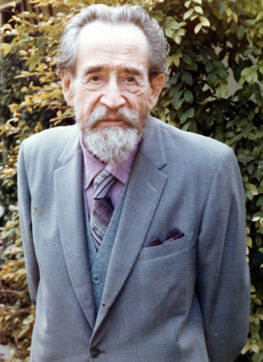
Archives — 1982
An interview with Dane Rudhyar
Conversation conducted by Samuel and Eve Djian-Gutenberg — published in L’Autre Monde, 1982
In 1982, while Samuel Djian-Gutenberg was following the teaching of Dane Rudhyar, an interview with him was arranged. Published the same year in the magazine “L’Autre Monde” (now defunct), it is transcribed here in full. The conversation took place in French, Rudhyar’s native language.
Eve Djian-Gutenberg: We are at Dane Rudhyar’s home in Palo Alto. Dane Rudhyar is French by origin and has lived in the United States for many years.
Dane Rudhyar, you are a musician and composer, a painter, a poet, an astrologer and, above all, a philosopher of the new age. What does “philosopher of the new age” mean to you?Dane Rudhyar: The new age, naturally, means many things in relation to the people who think about it. One should not, I believe, make it something too defined and too clear-cut, because if one does that one tends to present it in an entirely dogmatic way.
Eve: It is true that, for you, dogmatism belongs to the old culture.
Rudhyar: Yes, indeed. When I left France long ago, I realised that many things were going to happen which, in general, represented the more or less gradual disintegration — perhaps very slow but almost inevitable — of a culture that has passed through all sorts of phases and which, like any culture, will inevitably transform itself, and not only transform itself but sometimes disintegrate almost entirely under the pressure of new peoples or new ideas.
Eve: In what year did you leave France to come to the United States?
Rudhyar: I left France in 1916, when I was 21, during the world war, to give performances in New York and to have the symphonic poems of my music played at the Metropolitan Opera in New York, for a kind of ultra-modern dance festival which did not succeed at all…
Eve: … at the time (laughter).
Rudhyar: In fact the concert took place on the very day America entered the world war, the First World War. But I stayed here most of the time, especially in California, because at that moment in particular it seemed to me to be a virgin ground on which I could, in a sense, sow myself like a seed formed in Paris, where I was born — a seed which in some way contains the whole past of its culture and of human life, but which also contains the possibility of a profound mutation that can transform all the implications of life in general, of cultural life and of individual life.
Eve: It is true that you speak a great deal of the individual. What is the individual’s journey in this coming of the new age? What meaning do you give to this revolution?
Rudhyar: The new age, naturally, can be seen in all sorts of ways. From the astrological point of view, the new age represents a period of some two millennia generally called the Age of Aquarius. But what we have there in astrology is not existential data but simply a structure. A structure which means that a great cycle of 26,000 years divides into 12 ages, and the Age of Aquarius is one of these ages, following the Age of Pisces, which we have just finished, or which is in the process of finishing — it depends.
For me, I believe it is not completely finished, but that we are in the period of transition between the Age of Pisces and the Age of Aquarius, which probably will not truly begin before the end of the next century.Eve: So this transition, this age of transition, brings transformations both of society and of the individual.
Rudhyar: Yes, all existential transformations take place through individuals — or rather persons — who are open, in some way, whose mind is open to the thrust of a new phase of human, planetary and terrestrial evolution. These people are open to this new thrust and give it a definite form, whether through philosophy, through the arts, or through ordinary life and the relationships between different people, between classes — in short, all the things that make up the fabric of society and of culture in general.
Eve: How can one become an open being?
Rudhyar (laughter): To be open, the first thing is not to be closed (laughter).
Eve: What closes us — is it the old culture?
Rudhyar: What closes us is habit. It is the things that have been established from birth by family, religion, social class, finances — in short, all the things that mark the environment, not only social but also psychic, of the human being when he is born, when he develops in childhood and in his studies. The school he goes to, the university, all those things. So the person who wishes to be individual — in my view, I make a great distinction between the person and the individual, which is not at all the sense in which these words are generally used.
A person is a human being who functions in the sense of the culture, who has developed and formed his mind and all his habits and all his personal reactions. A person in this sense has a collective character, because he is formed by a cultural collectivity. In my view, one can really speak of an individual or of profound individuality only when one has had the courage and the possibility to, in a way, disengage and commit oneself to becoming free of all the cultural, religious and social dogmas — when one has become an autonomous individual, who stands on his own field of action, and who gives to his life and to life in general a meaning that is truly individual, different from the meaning that the people in his environment give to it.Samuel: But this passage from the person to the individual does not happen so easily, and happens through a certain number of crises.
Rudhyar: Yes, naturally, because all organisations and everything produced by any culture and any society have a great deal of inertia — that is, inertia in the scientific and philosophical sense of the word, the resistance to change. Everything that is organised, all institutions, always have an enormous resistance to change. So one must, of course, break this resistance within oneself; and if one does not do it within oneself, one is not really in a position to try to break it outside oneself. And that is the unfortunate thing — it is what revolutionaries very often want, and even rebellious youth is very often against something but does not know what it is for. That is, there is a revolt which is emotional, but which is not based on truly new ideas and on principles upon which one can found a new culture, a new society, a new individual life. So that, in my view, is the saddest thing, in a way, regarding many recent youth movements — let us say since 1965, here in Berkeley in the United States, or in England, in Holland…
Eve: In France too.
Rudhyar: … in France at that time. It was a revolt because people did not want to remain committed to the old formulas, but without knowing where they were going.
Eve: And that toward which we must go — does your philosophy propose to give its meaning?
Rudhyar: That is what I have tried to do since I left France. Even while I was in Paris, my first book was written in 1911, when I was 16. A part of it was published by Durand in Paris, but not the most important part, because he did not want the philosophy. It was on the cycle of musical civilisation and Debussy, who at that time represented modernity in a way. It was before Stravinsky’s Rite of Spring and all of modern music.
What I understood at that moment, in a way, is that we found ourselves in an autumnal period of European civilisation as we have known it — as it has been made since the end of the Roman Empire, and in a way even since the seventh or sixth century before Christ in Greece. And I realised that in the autumn woods there are always two things, two levels of life. There are the leaves, which are perhaps very beautiful, very golden, but which will rot, disintegrate and return to the humus, to the undifferentiated soil, the chemical element. But there are also the seeds, which are perhaps not very visible or not visible at all, and which seem to have no deep meaning or value, but which nonetheless keep within themselves the possibility of a new life. So my aim was always to try to be like a seed, and to try to establish the foundations on which a new society, a new culture, could be based. I believed, at that time, that this was the possibility for the United States of America to become that virgin field. I was very largely disappointed, in the sense that life here has, in a way, magnified rather than changed what I considered the errors of European civilisation — magnified them without keeping the most valid things that supported and gave a deep and solid basis to that sense of excessive individualism which manifests itself everywhere in the United States in particular. But, nonetheless, there is a certain openness to new ideas. There is an openness to the East, to Asia, which opens up many possibilities, and I have tried to do my best to bring out these possibilities. Which has not been easy at all, because it took about 40 years before my books were very widely published in the United States.Eve: When did you discover astrology, and did astrology bring you a further element?
Rudhyar: Yes, astrology brought me a practical element which allowed me to establish, in a psychological, individual, personal sense, very general abstract and cosmic ideas — if you like — which I had more or less received from Hindu and Chinese thought, but which I tried to transform, to modernise, because the individuals who receive these thoughts from ancient Asia have been formed in a completely different way from the formation that pupils and students in India and China received many centuries ago. So the soil on which these ideas are sown is so different that, naturally, one must also modify at least the formulation.
Eve: Can one say that you introduced a dynamic element into astrology? You speak of cycles, you speak of cyclic evolution.
Rudhyar: Yes, I tried to humanise astrology — an astrology of the personality. My first major volume was called The Astrology of Personality.
Eve: In what year was that?
Rudhyar: It was published in 1936. I really began to write it in 1933-34, and that was the time when I began to publish series of articles in the American magazine “Astrology”, which started at that time and which was responsible for the popularisation of astrology not only in America but in the whole world, indirectly if not directly. I had known the editor Paul Clancy, who was very interested in my ideas and gave me carte blanche for everything I wanted to write. Then other magazines came, because “American Astrology” was very widespread and brought in a lot of money, so many new magazines asked me to write. Sometimes I wrote 4 or 5 articles each month for years, so that I have probably written a thousand articles on astrology in any case — taking the astrological charts of philosophers, statesmen, musicians or psychologists, and developing their charts, showing how the interpretation of their birth charts gave a very interesting perspective on the ideas they developed in their books, in their discipline.
So one can take the birth chart of anyone who does something important, and then, under the guise of doing astrology, one can also do philosophy and politics, or anything — psychology — and so half of that magazine was entirely about psychology and astro-psychology or cosmo-psychology, and I wrote almost all the articles, sometimes even under different names.Eve: In what way does your astrology differ from traditional astrology, or from another astrology known in France and in the United States?
Rudhyar: The source that seems to me most important, and what I have tried to do, is to interpret and to give a positive and transforming meaning to all the facts of human existence, and particularly of personal existence — whether of a person or even of a nation or any collectivity that is definitely born at a particular moment.
Astrology has been defined as the science of beginnings, because it is based on the idea that the start, the first moment, the creative moment of an existence gives the essential structure of that whole existence. It is a question of structure. It is not a question of facts, of events. The unfortunate thing is that astrology in the past was above all interested in events: what is going to happen? When will it happen? What should I do at this moment, at that moment? In my view, astrology cannot give precise predictions — and less and less so, as our life becomes more complicated, as individuality becomes freer, more disengaged in a way from the social and cultural structures that formed it and consequently made it move within rather rigid, and therefore predictable, frames.Eve: What, then, is the task of the individual in relation to his birth chart?
Rudhyar: Astrology interprets the fact of birth in relation to the vaster facts that have taken place in the organised milieus in which one lives. Now, the organised milieu in the deep sense of the term is the solar system, because we are, in a way, citizens of the solar system. All our life, all our energy comes from the Sun, and the internal movements of this system represent, symbolically, the state of the relationships between the different functions of our physical organism. It is in this sense that one can say that man is a microcosm of the macrocosm. The macrocosm here is the solar system.
Astrology has to do with the way in which the different functions — whether of the body or of the psyche, because the two are more or less parallel or synchronised — unfold, and what the relationships are between them. These relationships produce the general structure of the life of a particular person born at a precise time in a precise place. So to bring out this meaning is to bring out what the Hindus call the Dharma of that individual, the reason for his birth. Why were you born? You were born to answer a certain need of humanity at a certain moment, in a certain place.Samuel: That is what you call, somewhere, the tone of the individual.
Rudhyar: The tone of the individual is the deep vibration that sustains his existence from birth to death. This deep vibration, which psychics or adepts are able to hear and to realise, is the profound support of all the biological and psychological activities.
The birth chart gives us, in a way, a mandala, an essential structure that allows us to see the relationships between all the functions that are part of an entire personality, and also how these functions develop in the course of life, if one studies what astrologers call the progressions, directions or transits, which are the unfolding in time of this structure. But a structure that unfolds does not mean a series of fateful circumstances or events, because human relationships, the relations between all beings, are so complicated that the existential facts themselves are not what counts; what counts is what the individual, the individual consciousness, makes of these events in relation to the deep structure that characterises it. Everything that happens to you in life, you should give it a deep meaning, a symbolic meaning that represents a phase of development of your consciousness, of your spirit, of your mind — and consequently everything that happens is good. In an astrological chart there is nothing that is bad or good; there are things that are necessary for the development of this structure, of this dharma.Samuel: So, to pass from the person to the individual…
Rudhyar: The passage from the person to the individual is something a little different from what I had begun to say a while ago. Astrology can be understood on two levels that are fairly clearly distinguishable.
I spoke first of a humanistic astrology. The word “humanistic” was not very good, but I used it because there was a movement in psychology called “humanistic psychology” in the United States which tried to give psychology a weightier meaning, different from Freud and also from laboratory research. A psychology centred on the person, on the development of the human being, of his faculties, of his consciousness and of the possibilities of development of his whole being. But this movement also recognised very quickly that what mattered most was the possibility of developing beyond, in a way, the person as it was completely defined by its culture and its tradition of the past — and the possibility of developing, beyond the person, something larger, vaster, that included much more than the rather rigid frame of a social class or of a personal state defined by a family, a social education, all that. So they spoke of “transpersonal psychology”, which included many studies on mysticism, on supernormal states of one kind or another. The movement, in my view, was not important enough, in the sense that it was so impossible for them to avoid an absolutely empirical and scientific attitude that they did not really want to open themselves to a new philosophy going beyond the rational state of the culture — particularly in France, or in Germany, and in England still more — because of all the concentration on empirical facts rather than on general ideas. So I too began to use the word transpersonal, which I had already used in 1930, but in a rather different sense. A sense that represented the realisation of a possibility of existence superior to man as we know man at this moment, and the possibility for a human being, for an individual, to make himself an agent, a focus through which great ideas and great evolutionary movements could concentrate.Eve: So it was first necessary to change the very structure of thought.
Rudhyar: It was necessary to try to establish a basis on which this change, this mutation in a way, from the past to the future, could express itself. There it was rather difficult, naturally, because it represents the need for a metaphysics rather different from the more or less religious metaphysics on which European thought has developed for more than two thousand years.
Eve: And that is where the philosophy of the East came in?
Rudhyar: Yes — a philosophy, it is rather difficult to speak of in a few words naturally, but one that establishes the possibility for the human being to become more than he is at this period and at the present stage of his evolution.
It is an effort to formulate, from the human point of view, what is implied in the idea of evolution, particularly of Bergsonian evolution, or the evolution of a being such as Jan Smuts, who wrote his book “Holism and Evolution” after the First World War, which shows that everything proceeded in a progressive way from a simpler whole to a more complex whole. From the atom to the cell, from the cell to the body, from the body to the social personality. And so the idea I wanted to express in detail was that which is beyond the strictly cultural and social personality. In this, in a way, I came close to Asian thought, Hindu and even Chinese — but in a fairly new way, because less occult, and not in a practical manner but more philosophical and psychological. That is what I have tried to do in recent books which are not yet published in France or other countries except America: The Planetarization of Consciousness, The Rhythm of Wholeness, and other books of this kind which study the possibilities of transformation of the human being.Eve: To return to the birth chart, in what way can a birth chart express this possibility of going beyond, of transformation, and what is the role of the astrologer?
Rudhyar: The birth chart must first be considered from the personal or humanistic point of view, in the sense that one must first know what one is and what the personal basis of your existence is, the reason for your birth and all that.
In a chart there are elements that can be definitely linked to the possibilities of spiritual transformation, if you like — although the word spiritual, naturally, especially in France, is very ambiguous, and one never knows exactly what is meant when one uses it, or when people use it. In the astrological chart, the planets beyond Saturn — Uranus, Neptune, Pluto — are essentially agents of transformation. They are the agents, the forces; they represent, they symbolise, forces that try to break the imprint of Saturn, which represents the boundaries, all that limits, all that defines but also constrains one to stay where one is. Naturally, one must begin by being somewhere.Eve: That is to say, the Saturnian structure must exist before one can go beyond it.
Rudhyar: Yes, one must first be a person before one can be depersonalised and pass beyond personality and individuality, in a sense, into a state of existence where everything interpenetrates, where nothing is completely, exclusively what it is.
The principle of exclusivity, which is the basis of modern science, is a principle that really applies only to the strictly physical point of the body. From the spiritual point of view, all beings and all things interpenetrate. There is an individuality, but this individuality is not exclusive. Everything is connected to the whole — and in a very interesting way. It is the conclusion of quite a lot of new physics: nuclear physicists, for example, are beginning to understand that everything is connected to everything, that everything is contained in everything, in a way. It is an old alchemical, hermetic adage that many scientific ideas are now beginning to understand, because it is the relationships between all things that are the important things. So your birth chart gives you the basic relationships between all the elements of your personality, but it also gives you an indication or a suggestion of the way in which these relationships can be seen in a different light that gives them a new meaning. It is not that you change personality, but that you give to this personality a new meaning in relation to a community, if you like, much vaster and much more spiritual, which encompasses the whole of humanity — not only humanity in its physical sense of the human body, but humanity as a spiritual and planetary being. Do you understand what I mean?Eve: Yes — well, we are trying not to lose our footing. You speak already of the holistic principle: can you speak to us of the force that allows us to integrate knowledge, our consciousness and the mind? Can you enlighten us on these questions?
Rudhyar: I do not quite understand. What force?
Eve: I think I will repeat the question. At these different levels of consciousness, is there a light that can be common to us? What is there that always allows us to integrate new levels of consciousness?
Rudhyar: Well, if you take the idea of evolution very seriously, the one thing you should understand is that there is an evolution which has phases, levels beyond the human being as we know it now in its strictly cultural, national state, defined by institutionalised religions that are very restricted and that have precise dogmas and things like that. This evolution is a great thrust that goes from the atom, to the cell, to the human personality, and which continues higher, further, and takes in the whole planet, the solar system, the galaxy. There is no reason to stop at the human personality as we know it at present. The only way in which we can really — it is perhaps not the only way, but the most logical way — try to pass to a higher, more inclusive stage of consciousness, is to establish this consciousness upon total humanity and not upon a restricted humanity: Europe, America, India, China, Egypt, which are local cultures.
There are, naturally, enormous difficulties, and the greatest of the difficulties is the prodigious and fantastic number of human beings on the earth, which I believe makes no sense and which has exceeded all constructive limits. And it is, unfortunately, a fact that people do not want to consider most of the time, because biological thinking is always so strong for present humanity that one does not like to speak of the proliferation of the masses of human beings on the earth — which, in my view, goes beyond any possibility of establishing a truly planetary and truly spiritual thought, in a sense that includes much more than the local thoughts on which cultures were once built. Each culture has always been founded on a geographical region, attached to the earth a little as an egg is attached to the womb of a woman. This attachment to the earth from the strictly physical point of view: to the climate, the vegetation, the animals and all that. All this was what formed a local culture, a particular culture; now the higher level is a stage that is based on the principles of cosmic order, of a more general order, at least planetary if not super-planetary.Samuel: Do you think that between each stage of the evolution of man there is the necessity of an incarnation of a specific man who is the bearer of this new seed — or of several men, of what you call avatars?
Rudhyar: Yes, I believe the idea of an avatar is simply the idea that a new phase, a new stage of human evolution, has a kind of essential character, an essential rhythm. It is a new vibration that forms on the planet in a way, and this vibration can incarnate in a being who becomes, in a way, the spokesman — but it is more than a spokesman; he becomes an agent, becomes an incarnation of this new rhythm. Sometimes it can be a being who can have a body that resonates to a different vibration. Sometimes it is a man whose mind, whose mental spirit, is capable of conceiving new thoughts and new relationships that were not much understood in the past. Sometimes it is a personal totality that becomes a great symbol, an exemplar — I do not know what you call it.
Samuel: A model.
Rudhyar: A model, if you like — as, for example, Buddha or Christ, who become, in a way, focuses in which the diffuse light of a new stage of evolution concentrates, in a sense. This can happen in a restricted state or in a general state. But it is always the thing that matters most.
Eve: Furthermore, would you have a message especially for the young, in France, in French — words of hope concerning youth?
Rudhyar: It is rather difficult for me to say, because I have not been in France for 25 years, and things have certainly changed a great deal during that time. What I always say to the young here, who are no doubt in the same state, is that it is not enough to decondition oneself — I do not know whether you have that word in French.
Eve & Samuel: Yes — to decondition oneself.
Rudhyar: … to decondition oneself, but that one must re-establish oneself, build oneself on a new foundation. So all the things that happened under the hippy movement in California, in America, and probably in Europe too — whether in art, in music, in painting or in life in general — all that is part of the process of deconditioning rather than of construction. But then, to build, one should have a model, a plan, a scheme of what one wants to build, or at least know and understand what the new structure must try to reveal to us. So that means the development of the mind — but not the mind in the classical sense, the rigid intellectual point of view of the Cartesians, or academic thought, but a mind that is completely open to the global thought of humanity, and particularly to the cultures that have developed in a way quite different from the way our culture has developed.
But that does not mean becoming a very devoted student of an ancient culture or an ancient religion, because then one simply passes from one dogmatism to another dogmatism. Rather, it means trying to bring out the essential, profound ideas and to build on those.Eve: In a way, to make the synthesis.
Rudhyar: Yes, the synthesis. It is a little more than synthesis, because the synthesis becomes a kind of virgin field on which a new rhythm can emerge. It is not a matter of passing from one thing to another, of pecking at a kind of seed, but of trying to know, to identify oneself with the evolutionary movement of humanity, and of trying to understand what the new step is, what the new stage of the human state is that must develop in this famous new Age of Aquarius. We are now, I believe, in a period of transition; nothing has really begun.
Eve: With all the confusion that this entails, unfortunately.
Samuel: All the confusion that this entails.
Rudhyar: But one must have a great deal of courage…
Eve: Thank you very much.
Rudhyar: … and perseverance.
Eve: Yes.
Samuel: Thank you.